
Carriers of Kindness: African American Leaders in Early Animal Welfare
In honor of Black History Month, we wanted to explore the important role that African Americans played in the early days of the animal welfare movement. The histories of post-Emancipation African American communities and the burgeoning animal protectionist movement are both deeply complex. Where these histories intersect, we find powerful stories of individuals who bravely worked toward a more just, compassionate, and peaceful world for all beings.
The modern animal welfare movement in the United States is generally traced back to the first chapter of the Society for the Prevention of Cruelty to Animals, founded in 1866 in New York City. That year, Henry Bergh wrote what became known as the Declaration of the Rights of Animals for the New York charter, helping to establish anti–animal cruelty laws in the United States.
In 1866, America was still reeling from the long and brutal Civil War. This declaration of rights followed the Emancipation Proclamation by only three short and volatile years.
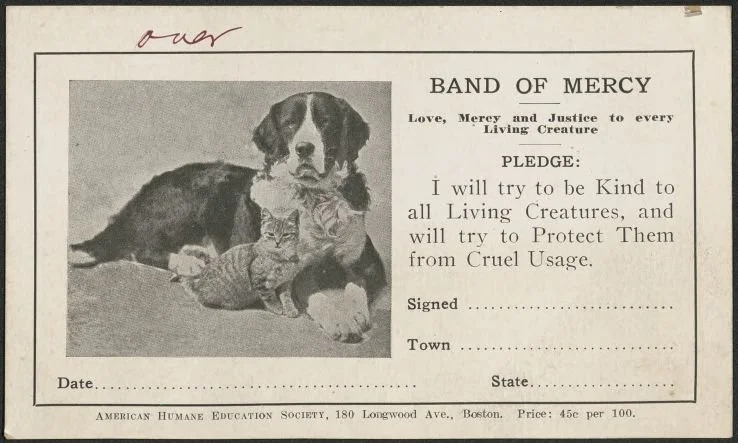
Not surprisingly, recent scholarship suggests that many Americans at the time, particularly those living outside major urban centers, were more likely to associate animal protection efforts with smaller, local groups known as the Bands of Mercy. By the end of the nineteenth century, there were an estimated tens of thousands of Bands of Mercy chapters (as many as 27,000 reported) operating in the United States. A prominent feature of these chapters was the use of traveling speakers (more on this below), among whom African Americans played prominent roles. Some of these speakers, including individuals born into slavery, traveled widely across the country and were instrumental in the creation of hundreds of local chapters. These chapters would go on to exert a profound influence on animal protection laws and humane education in the United States. African Americans played a significant, and often overlooked, role in this work.
In the years following emancipation, animal welfare advocacy unfolded alongside broader movements for social reform in the United States. Questions of justice, dignity, and compassion were being actively debated in many public spaces, even as deeply entrenched racism continued to shape who was heard and whose lives were valued. Within this context, efforts to promote humane treatment of animals faced the same social limitations and resistance that confronted many reform movements of the era.
For those living in Tennessee, the story of William Key offers a remarkable example of early animal advocacy. Born into slavery near Winchester, Tennessee (a short hour and a half from where I am writing), Key went on to become a celebrated nineteenth-century veterinarian, equine dentist, and horse trainer. Largely self-taught, “Key read veterinary texts and experimented with animal remedies until he became a successful veterinarian and equine dentist.”
Reverend John W. Lemon was another influential figure in the early animal welfare movement. In the early twentieth century, Lemon helped organize more than 500 Bands of Mercy chapters and delivered nearly 1,000 public lectures across the country. His work extended well beyond animal protection alone.
As historian Janet M. Davis writes in The Gospel of Kindness: Animal Welfare and the Making of Modern America, “Lemon’s lectures on animal kindness and civilization dovetailed with his other human-centered topics on racism and economic inequality.” For Lemon and others like him, compassion for animals was inseparable from broader struggles for justice and human dignity.
Prominent organizers of the Bands of Mercy, including Key and Lemon, educated soldiers on the humane treatment of horses in the army, while local chapters held public meetings featuring songs and stories centered on compassion and humane treatment for all living creatures. Children were encouraged to take lifelong pledges to be kind to animals. By 1909, more than one million children were reported to have taken the Jim Key pledge to treat all living beings with kindness.
Despite significant obstacles, African American advocates carved out spaces where they could educate, organize, and inspire. Through the Bands of Mercy and other local initiatives, they taught children, gave public lectures, and promoted humane education, often with remarkable ingenuity and determination. Their ability to influence both animal welfare and social reform illustrates the resilience and leadership required to navigate a movement that was, at times, reluctant to include them.
Below are links we hope will serve as a springboard for readers to further explore the lives and work of these individuals, nearly lost to history, and to find inspiration for how their legacies might inform our own lives today.